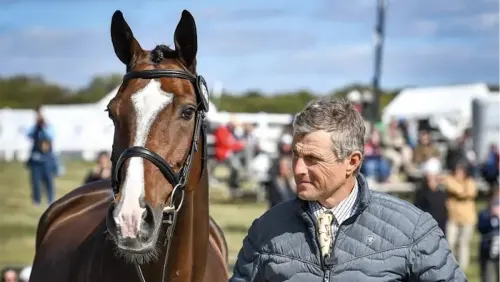
Pierre Le Goupil says he was not “born on the back of a horse,” but the reality is close to that. The day after he was born, Le Goupil’s father, top French eventer André Le Goupil, headed off to compete at Burghley (England), and horses were an integral part of Pierre’s upbringing. He was raised on the family farm, tearing around the Normandy countryside in France on a multitude of ponies, unhindered by the strict rules of a riding school.
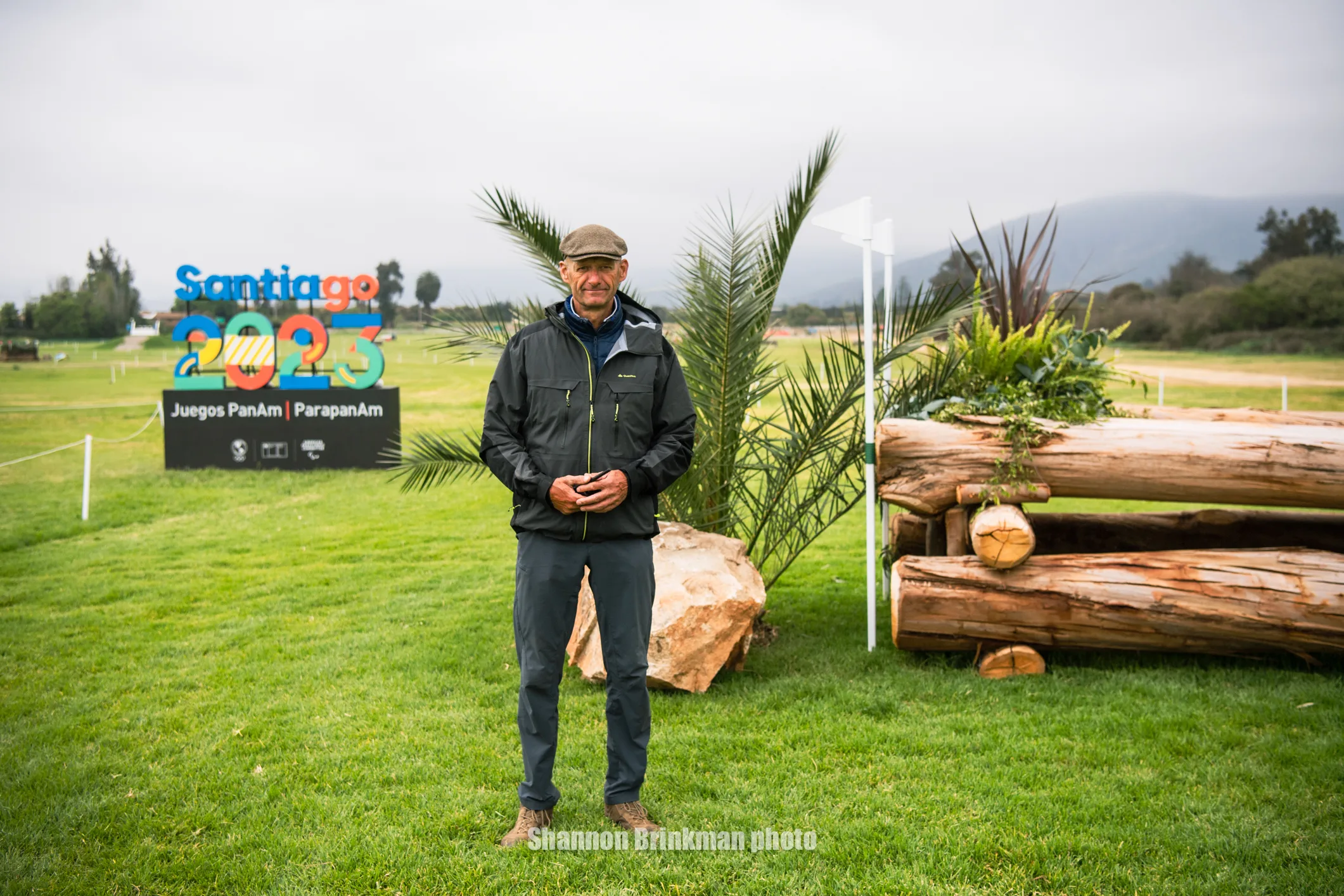
Pierre competed at the top levels of eventing for nearly 30 years, and along the way picked up a passion for designing cross-country courses, as well as helping his family develop the Le Grand Complet event, which was held at Haras du Pin in Normandy for many years. He was the course designer for the 2023 Santiago Pan American Games and for last year’s Paris Olympic Games.
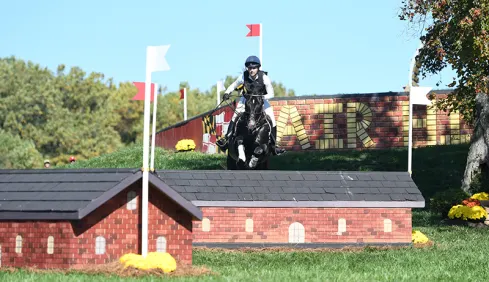
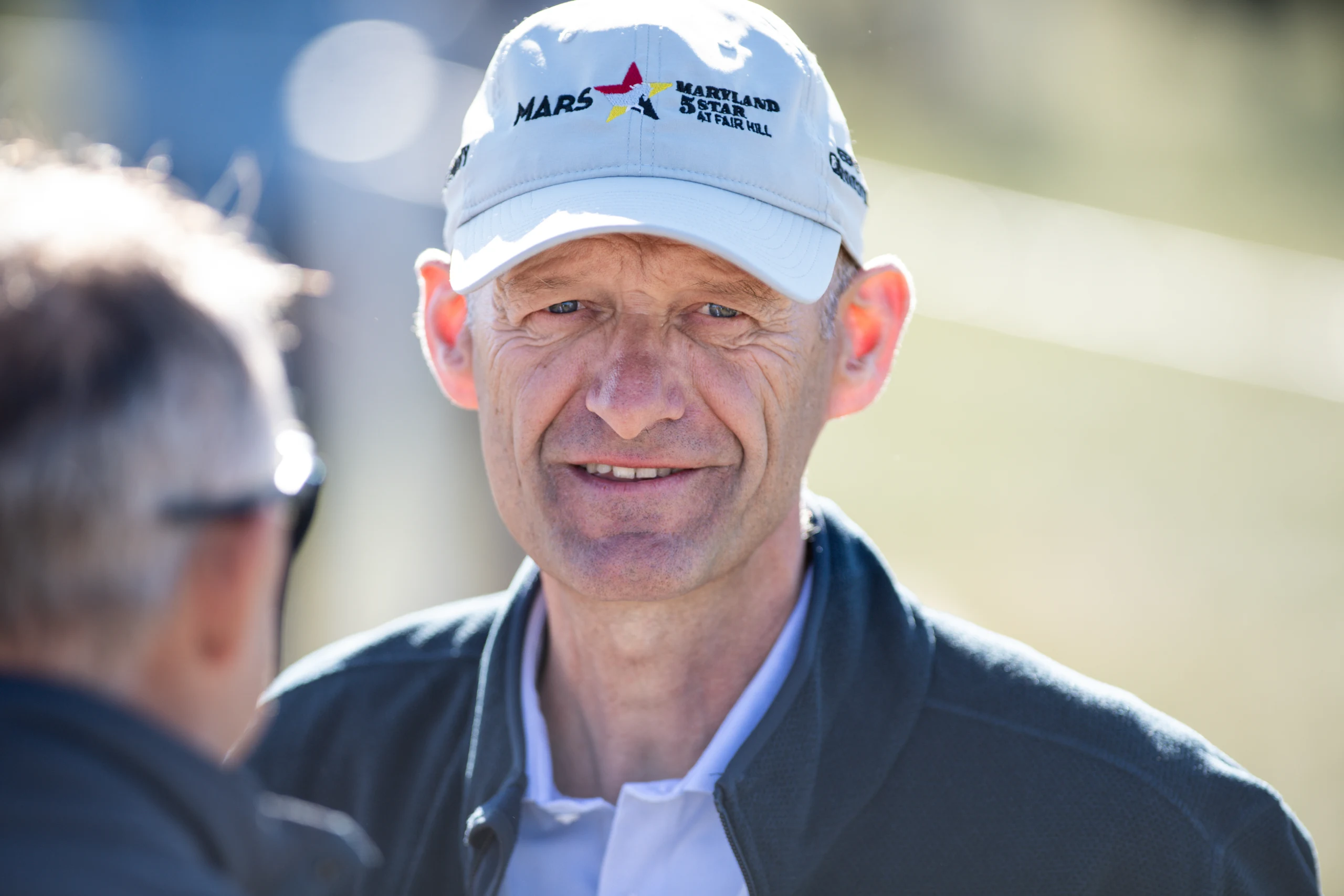
Today, Pierre, 63, is based in France, but he spends plenty of time on the road, working at events across Europe, Asia, and now the United States. This year he’s designing the cross-country track at the Mars Maryland 5 Star at Fair Hill for the first year, taking over the reins from previous designer Ian Stark.
How would you describe your course designing style?
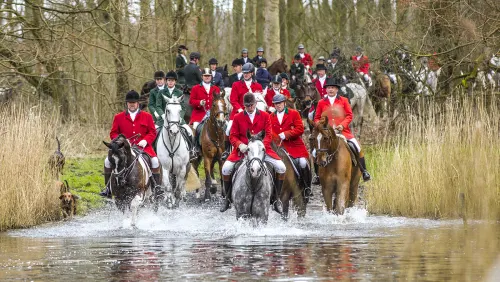
Where I grew up riding ponies, we had foxhunting not far from home, and to be part of that, and the countryside where it happens, was just amazing.
[There were] big hills, and they were covered with sheep grass, and then there were pine woods, and the sea of course. We used to go there with the ponies first, and later with horses, and so it was ups and downs and ups and downs all the time. It was a roller coaster.
I would say that it has given me a certain sense of balance, where you learn to attack the hill, galloping up the hill, then cool down and let the horse carefully find his balance and everything, and then go down, and then rush down, and then go up.
I’m always learning to follow the level lines to find the best way for the horse, because when you’re galloping in a pack of 50 horses, you can’t always see what you have in front of you, and you have to rely on your horse. When you go up the dunes, you don’t know what is behind them.
That was very influential, because this is what I try to do when I design: I try to read the terrain and the ground.
What was the experience of designing for the Olympics in your home country?
I’ve been very lucky. I was not necessarily the one on paper who was going to do it. When I was nominated, I’d never [designed at] the Europeans. I haven’t done a five-star. I wasn’t a big name as a rider myself.
But the context of Paris, with the publicity and having the competition in Versailles, was in favor of my nomination. It was an advantage to be French.
I know I was respected as a designer; I’ve been designing four-stars for almost 20 years—successfully, I would say. And I have the experience of working with different teams, and that played in my favor.
In the end, it was a fantastic experience working with all the teams.
What was your vision for this first year designing at Maryland?
Working with [course builder] Tyson Rementer and the team over there is the dream. Tyson is a real character, and it’s really enjoyable.
I like working with them because they can help transform your ideas. You can discuss, and you come with ideas, and through the discussion it develops and brings you more ideas. The different meetings I had with the team made me more confident and comfortable.
This year the weather is a little better than last year. At the moment it’s completely green there. The ground has been good because they’ve had regular rain.
ADVERTISEMENT
We discussed [the course] a lot with Ian last year, and he’s going to be in Maryland to mentor me and help make the final adjustments, because it’s my first one, and it’s good to have someone of his caliber make sure it’s right.
I have in mind the idea of sending a message to the riders—so that they have a goal to go there—that the course is achievable in terms of fitness, technicality and everything. I hope we will achieve that this year. We are used to having many more starters in European events, and we would like to attract more starters in Maryland this year, create envy [from people who aren’t there], and make sure the riders are not worried or thinking it’s too much for themselves or their horse. But we want to do that without downgrading the level of the five-star. I want to make sure people enjoy it and have fun, while still having the highest quality of event.
I certainly wouldn’t want my comments to be interpreted as: Last year the course was too hard, it wasn’t good, and now I want to fix it. For me, the first challenge is stepping into Ian’s shoes properly and ensuring a transition that isn’t a revolution—because that wouldn’t make sense. The work my predecessor has done is tremendous, and he has shaped a venue that, of course, will continue to evolve, just as it would with any course designer, even Ian himself if he had stayed on. He gave the event a style that needs to be preserved and built upon, and that’s the standard I want to live up to.
For me, the first challenge is stepping into Ian’s shoes properly and ensuring a transition that isn’t a revolution—because that wouldn’t make sense.
Now, I think Ian would be the first to want to see the cross-country phase evolve, because last year the scores were a bit high, and we need to temper that level of difficulty, so it doesn’t work against the event. [Editor’s note: At last year’s Maryland, eight of the 22 starters finished cross-country.]
Riders shouldn’t view this competition as too demanding—either for themselves or for their horses—especially when there is a real pool of potential five-star competitors in North America. Just look at the Kentucky Three-Day Event, which has gradually grown over the years and now has reached maturity. That kind of maturity takes time to build, but maybe also requires some steady fine-tuning, so the event remains attractive.
There’s a clear “fitness factor” at Maryland that can’t be denied, and we can’t change that; it comes with the terrain. From Point A to Point B it goes up, down, up again, down again. It’s demanding for the horses. The challenge is to try to smooth it out and make it a bit more accessible.
The new elements in this year’s cross-country design came from a convergence of interests: I wanted to use the terrain earlier in the course—bringing in some elevation gains right at the start, making more use of the area usually favored for young horse classes. That way, riders get straight into a cross-country rhythm I find interesting before heading into a closed arena.
Coincidentally, the organizers welcomed this idea because it also solved some logistical challenges with the flow of people, equipment and safety management between the east wing and north wing, which the course used to cut across.
The smooth communication and collaboration I’m enjoying with the organizers can only help foster creativity and lead to the best result. For course designers, the line between “not enough” and “too much” is very thin.
Ian, with his knowledge of the site and of the North American competitor pool, is an incredibly invaluable ally. Fine-tuning those details often comes down to very little—and it’s an incredible privilege, and really a great compliment, to have someone like Ian Stark, who has nothing left to prove, agree so enthusiastically to work alongside me.
What are your favorite places you’ve gotten to visit as a course designer?
They are all interesting and exceptional. I’ve been in many different places in Europe, and they’re not always the easiest to work in. I went to Bulgaria, Belarus, Hungary. I was even in Russia, in Moscow, before the war. It was a wonderful venue in Moscow, and we had big projects in place with the owner, and I was delighted to work there, because these people were starting to be part of the sport. It was a very impressive place. I could compare it—on a slightly different scale—to the World Equestrian Center in Ocala (Florida).
Then Japan, I really love that place. Where I’ve been working, Yamanashi, is a small venue for lovely competitions, and it’s a gorgeous place. If you look at the cross-country, you’ll see the mountains and pine trees in the background. I like the people there, and the food.
There are still many, many places to discover. The places with the biggest possibilities are the most memorable, [especially] if you deal with people that want to do something and be part of it and want to learn it. That’s always enjoyable.
Tell me about your first horse or pony.
Because we lived in Cherbourg, where there was intense ferry traffic with England, we were sometimes asked by the customs veterinary services to host some horses.
ADVERTISEMENT
One day a huge lorry full of ponies arrived that were meant to go to some merchants. They ended up staying [at our farm] longer than expected, and after two weeks my father bought three of them. I fell in love with a little mare, completely black, that I called Flicka, like “My Friend Flicka.”
The problem was that we didn’t know how old they were, and they weren’t even broken, but we did it. We used to go and gallop around with no saddle, and after two weeks the mare went lame. Our vet came and discovered that she had some issues with feet and that she was 2 years old, so then she had a break, and the year after we started the same with her—playing around in the woods, from morning to evening, and then I became too big for her. But she lived to be 39.
What characteristic do you value most in a horse?
The expression, the way the horse looks at you. I say, “The way the horse looks at you,” but you could also say, “The way the horse looks after you.” So when you go to the field or in the stables, the way the horse looks at you, and the harmony of your connection that takes you as far as you can.
You have some horses that have fantastic ability and quality, but for some reason they don’t have the same heart. They do not have the same ability to connect with you. It goes both ways, but it’s easier with some horses than other ones.
What characteristic do you value most in a human?
Loyalty, because it’s not always there.
What horse, past or present, would you most like to ride?
My junior mare, Farah. I would love to ride her again.
My wife started to do some breeding, and we started to breed with the grand-daughter of that mare, and it’s very promising. When I told you that one of the most important things is the way the horse looks at you, when you look at that mare, she has a personality. She looks at you; she keeps the head straight, and the eyes follow you. That’s unique.
She never looks like she’s dominated. She’s always taking you. She has a big heart, and it comes from her grandmother, that was my junior mare.
What would you consider to be your biggest accomplishment?
My two daughters. My wife, Yannick, and my daughters, Zara and Camille, for sure. I’m a happy man with a beautiful family. I lost both my parents within two years—my dad before the Olympics, and my mom quickly after the Olympics—so I really know that family is very important, and I’m very proud of my wife and my daughters.
If you weren’t working with horses, what would you do?
I’m a really big fan of sailing. I’ve done it a bit when I was younger, and when I have the occasion, I love to go with friends.
What three items are always found in your refrigerator?
Cheese, beer and cider, water with lemon juice.
Editor’s note: This conversation has been edited for clarity and space.
This article originally appeared in the October 2025 issue of The Chronicle of the Horse. You can subscribe and get online access to a digital version and then enjoy a year of The Chronicle of the Horse.